
Redundant buildings wanted in Lincolnshire
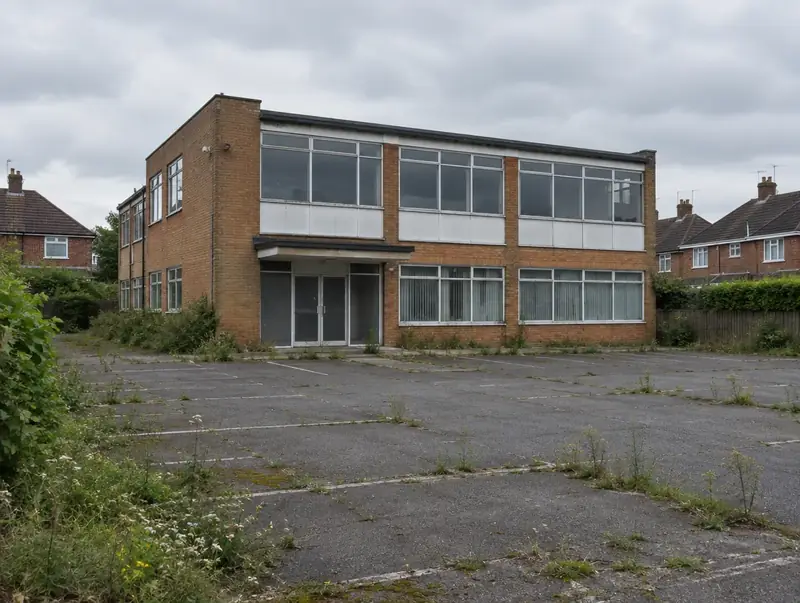
We are actively looking for redundant buildings in Lincolnshire and the surrounding area, with or without planning permission.
If you own a building that no longer works for its original purpose, it may suit residential conversion or redevelopment. We consider offices, retail, pubs, community and religious buildings, and more.
- Size
- Any
- Planning
- With or without
- Areas
- England & Wales
- Ways we buy
- Outright or conditional
Redundant buildings we are looking for in Lincolnshire
Lincolnshire, as used here, includes the Humber towns of Grimsby, Scunthorpe and Cleethorpes as well as Lincoln, Boston, Grantham, Spalding, Stamford and Skegness. There is no Green Belt, but the Lincolnshire Wolds National Landscape covers part of the county and much of the south and east lies in low-lying fenland and coastal marsh at high flood risk. Typical sites include edge-of-town fields, farm buildings, village infill and former industrial land.
- Vacant offices and commercial buildings
- Former pubs, halls, chapels and churches
- Buildings with or without existing consent
- Sites where demolition and rebuilding may be better than conversion
Flood zones and the sequential test often decide what is possible in the Fens and along the coast, so sites on higher ground or within existing towns are favoured. The A1 corridor at Grantham and Stamford, the Lincoln area and the Humber ports see the most interest in larger housing land.
What decides whether a site in Lincolnshire works
Community value
Pubs and community buildings may be listed as assets of community value or protected by policy.
Prior approval (England)
Some changes of use can be made through permitted development with prior approval.
Parking and amenity
Homes need outdoor space, bins and parking where the council expects it.
In England, the revised National Planning Policy Framework published on 17 August 2026 replaced the old "tilted balance" with new settlement policies: development within a settlement should normally be approved unless the harm substantially outweighs the benefits, while land outside a settlement can gain support in defined circumstances.
The August 2026 NPPF supports homes within reasonable walking distance (around 800 metres) of well-connected railway stations, with minimum densities of 35 homes per hectare, or 45 near higher-frequency stations.
Lincolnshire has no designated Green Belt, so the main policy questions near Lincolnshire are usually the settlement boundary, landscape and access.
Redundant buildings wanted in towns across Lincolnshire
Choosing how to sell
Outright purchase
Common for empty buildings, with conversion costs reflected in the price.
Outright purchaseSubject-to-planning contract
We agree a price now and complete once a satisfactory planning permission is granted.
Subject-to-planning contractHow a sale to us works
Get in touch
Tell us where the land is and what you know about it.
Site review
We look at the land, its planning position and anything that could affect it.
Proposal
We put our proposal in writing, with no obligation to accept.
Exchange and completion
If you go ahead, contracts are exchanged and the sale completes on the agreed terms.
Redundant buildings in Lincolnshire: common questions
Can a former pub be converted to homes?
Sometimes. Pubs are often protected by local policy, and the August 2026 NPPF aims to avoid loss of valued community facilities, so evidence about viability and need matters.
Should I strip out the building before selling?
No. Leave it as it is and tell us about its condition; we will assess it as found.
Which planning rules apply to land in Lincolnshire?
As Lincolnshire is in England, national policy comes from the National Planning Policy Framework, revised in August 2026. Local policies in the council's development plan also apply.
Do I need to pay anything to have land in Lincolnshire assessed?
No. Our appraisal is free and there is no obligation to sell to us.