
Residential development land wanted
Land that could take new homes, from a handful of plots to whole neighbourhoods. England and Wales.
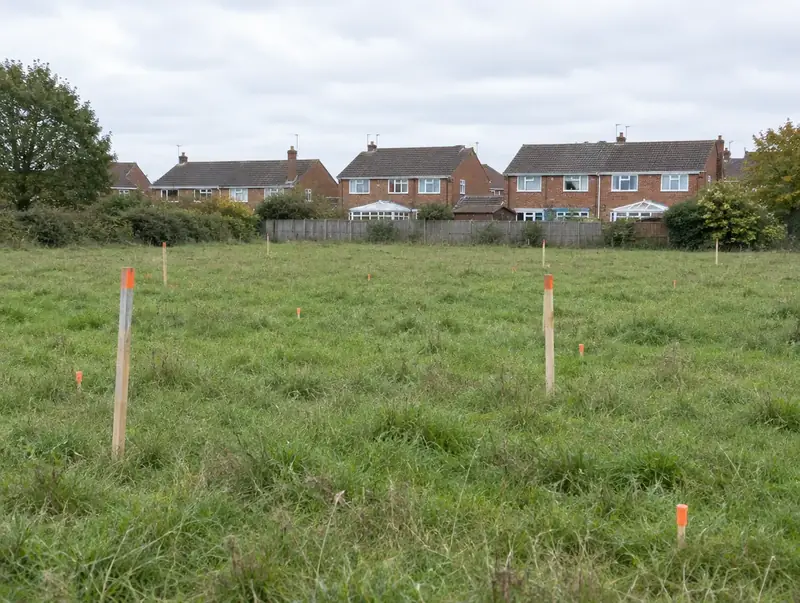
Residential development land is any site where new homes could reasonably be built, whether it already has planning permission or not. We look at land of every size across England and Wales and give owners a straight answer on whether housing is realistic.
- Size
- Any — single plots to 50+ homes
- Planning
- With or without
- Areas
- England & Wales
- Ways we buy
- All four
What residential development land do we want?
If a piece of land could hold new houses or flats, it counts as residential development land. That might be a paddock on the edge of a village, a yard in a town, or a field next to an existing estate. We assess each one on its own merits and say plainly what we think.
- Land next to or within an existing town, village or suburb
- Sites with a road frontage or a clear route to one
- Land outside the highest flood risk zones, or where flood risk only affects part of the site
- Sites with or without planning permission, including land promoted in a local plan
- Single plots, small sites, medium sites and larger strategic land
- Freehold land where the owner (or all the owners) can sell
What decides whether a site works?
Residential development land means a site with a credible route to new homes. Planning permission is not essential: much of the land we want has none yet. What matters is location, access and whether local policy could support housing in the next few years.
Settlement boundary
Land inside or touching a defined settlement usually has a clearer policy route than isolated land.
Access
A safe vehicle access with adequate visibility is often the single biggest make-or-break item.
Flood risk
We check the official flood maps early; land in the highest-risk zones is rarely suitable for homes.
Development plan position
Whether the council has an up-to-date plan shapes how applications are judged; in England, housing land supply also matters.
Utilities and drainage
Foul and surface water drainage, and power capacity, affect cost and timing more than most owners expect.
Is it different in England and Wales?
England. In England, a planning permission normally has to be implemented within three years unless the council sets a different period, and councils aim to decide minor applications within eight weeks and major ones within thirteen.
Wales. Parts of Wales lie in river catchments where phosphate levels in protected rivers affect new housing, so drainage and nutrient solutions can be an early question.
What should I have ready?
None of this is essential to get started, but it helps us give a firmer view sooner:
- A title plan or deeds showing the boundary
- Any planning history, pre-application advice or allocation details
- Details of access, rights of way and any tenancies
- Known issues: drainage, flooding, covenants, overhead lines
How we buy
Ways to sell residential development land to us
Outright purchase
Best where planning is already granted or the route to it is clear.
Outright purchaseSubject-to-planning contract
Common for land without planning: we agree a price now and complete once a suitable permission is granted.
Subject-to-planning contractOption agreement
Suits larger or longer-term land where planning may take several years.
Option agreementWhere
Residential development land wanted by area
Choose your county to see what we look for locally and the towns we cover.
England
- Bedfordshire
- Berkshire
- Bristol
- Buckinghamshire
- Cambridgeshire
- Cheshire
- Cornwall
- County Durham
- Cumbria
- Derbyshire
- Devon
- Dorset
- The East Riding of Yorkshire
- East Sussex
- Essex
- Gloucestershire
- Greater London
- Greater Manchester
- Hampshire
- Herefordshire
- Hertfordshire
- The Isle of Wight
- Kent
- Lancashire
- Leicestershire
- Lincolnshire
- Merseyside
- Norfolk
- North Yorkshire
- Northamptonshire
- Northumberland
- Nottinghamshire
- Oxfordshire
- Rutland
- Shropshire
- Somerset
- South Yorkshire
- Staffordshire
- Suffolk
- Surrey
- Tyne and Wear
- Warwickshire
- The West Midlands
- West Sussex
- West Yorkshire
- Wiltshire
- Worcestershire
Wales
What happens next
Send the basics
A postcode or plan and a few lines about the land are enough to start.
We do the homework
We check planning history, policy, flood maps and access at no cost to you.
We explain the options
You get a written proposal covering price, structure and timing.
Agree and proceed
Once you are happy, solicitors are instructed and the deal moves forward.
Questions
Residential development land: common questions
Does my land need planning permission before you will look at it?
No. Most residential land we are asked about has no planning yet. We look at policy, access and constraints and tell you whether we think a permission is realistic, and which way of selling suits the risk.
How small a site do you consider?
We look at single building plots as well as larger sites. Small sites can be very worthwhile, particularly infill land within towns and villages.
Can I sell part of my land and keep the rest?
Often, yes. We can look at selling an agreed area, with access and boundaries set out so the land you keep is not left landlocked.
Will you tell me if you think the land is not suitable?
Yes. If we think the site has no realistic route to homes we will say so and, where we can, explain why.