
Redundant buildings wanted in Derbyshire
Looking to sell redundant buildings near Derbyshire? We assess every site on its merits and explain the options in plain English.
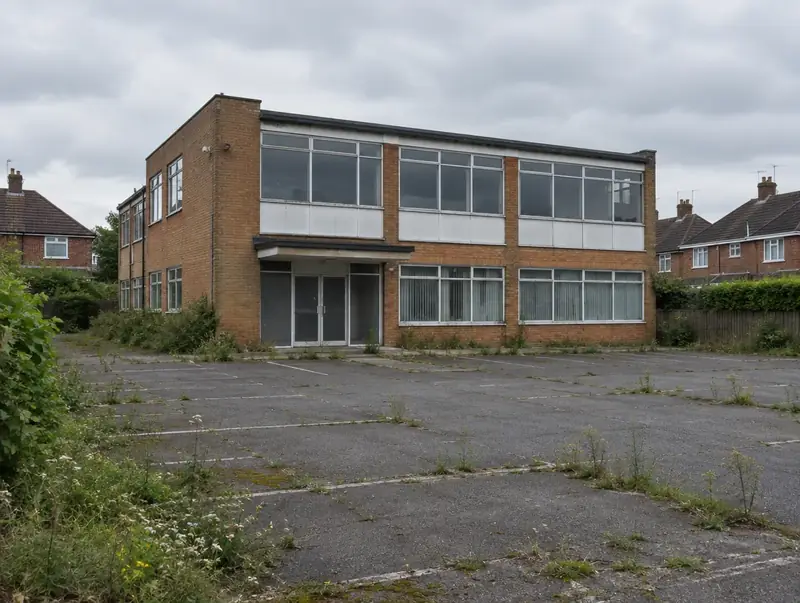
Redundant buildings are empty or underused buildings, such as offices, shops, pubs, chapels or halls, that could be converted or replaced with homes. We assess both conversion and redevelopment and buy suitable buildings across England and Wales.
- Size
- Any
- Planning
- With or without
- Areas
- England & Wales
- Ways we buy
- Outright or conditional
The redundant buildings that interests us around Derbyshire
Derbyshire stretches from the city of Derby and towns such as Ilkeston, Long Eaton, Belper and Ripley in the south and east to the Peak District uplands in the north-west. Green Belt covers land between Derby and Nottingham, near Swadlincote and on the edges of Sheffield and Greater Manchester, while the Peak District National Park covers much of the north. Former colliery and industrial land, edge-of-town fields and village infill are the usual sources of housing sites.
- Vacant offices and commercial buildings
- Former pubs, halls, chapels and churches
- Buildings with or without existing consent
- Buildings within towns and villages
Much of eastern Derbyshire lies on the former coalfield, where a coal mining risk assessment is often needed before building. The M1 corridor towns such as Chesterfield, Alfreton and Ilkeston, and the Swadlincote area near Burton upon Trent, see steady demand for small and medium housing sites.
Before we make an offer in Derbyshire
Community value
Pubs and community buildings may be listed as assets of community value or protected by policy.
Prior approval (England)
Some changes of use can be made through permitted development with prior approval.
Parking and amenity
Homes need outdoor space, bins and parking where the council expects it.
Since 6 August 2026, non-major development on sites of 0.2 hectares or less in England has generally been exempt from mandatory biodiversity net gain, unless priority habitat is affected. That makes many small sites simpler to bring forward.
English councils keep brownfield land registers, and some previously developed sites can be granted permission in principle, a quicker way of establishing whether housing is acceptable before technical details are settled.
Redundant buildings wanted in towns across Derbyshire
Four ways to sell to us
Outright purchase
Common for empty buildings, with conversion costs reflected in the price.
Outright purchaseSubject-to-planning contract
Used where consent or prior approval is still needed.
Subject-to-planning contractWhat happens after you get in touch
Get in touch
Tell us where the land is and what you know about it.
Site review
We look at the land, its planning position and anything that could affect it.
Proposal
We put our proposal in writing, with no obligation to accept.
Exchange and completion
If you go ahead, contracts are exchanged and the sale completes on the agreed terms.
Frequently asked in Derbyshire
Should I strip out the building before selling?
No. Leave it as it is and tell us about its condition; we will assess it as found.
Do you buy buildings that need demolition?
Yes, where redevelopment is the better option and the planning position supports it.
Can an agent introduce land in Derbyshire to you?
Yes. Estate agents, land agents and planning consultants can introduce sites with the owner's consent. Any fee is agreed in writing before details are shared, confirmed by the owner in writing and paid only on completion.
Do I need to pay anything to have land in Derbyshire assessed?
No. Our appraisal is free and there is no obligation to sell to us.