
Green Belt and grey belt land wanted in Derbyshire
We are actively looking for Green Belt and grey belt land in Derbyshire and the surrounding area, with or without planning permission.
Green Belt land is not automatically ruled out for housing in England. Land that qualifies as grey belt, or previously developed land within the Green Belt, can be considered under national policy, subject to the Golden Rules on affordable housing and infrastructure.
- Size
- Any
- Planning
- Usually without
- Areas
- England only
- Ways we buy
- Option or conditional
What Green Belt and grey belt land we want near Derbyshire
Derbyshire stretches from the city of Derby and towns such as Ilkeston, Long Eaton, Belper and Ripley in the south and east to the Peak District uplands in the north-west. Green Belt covers land between Derby and Nottingham, near Swadlincote and on the edges of Sheffield and Greater Manchester, while the Peak District National Park covers much of the north. Former colliery and industrial land, edge-of-town fields and village infill are the usual sources of housing sites.
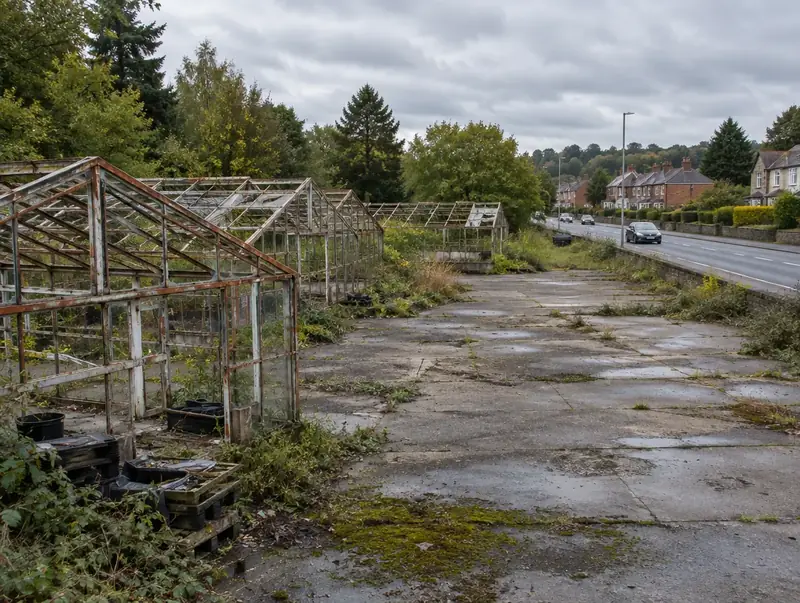
- Previously developed land in the Green Belt, such as yards, nurseries or old buildings
- Green Belt land on the edge of towns that is already enclosed by development
- Land near railway stations with good services
- Land with or without earlier promotion
Much of eastern Derbyshire lies on the former coalfield, where a coal mining risk assessment is often needed before building. The M1 corridor towns such as Chesterfield, Alfreton and Ilkeston, and the Swadlincote area near Burton upon Trent, see steady demand for small and medium housing sites.
What usually makes or breaks it
Affordable housing
The requirement is typically higher than elsewhere, which affects land value.
Local plan reviews
Councils may release Green Belt through their plans; promotion can matter.
Protected areas
Other designations, such as protected landscapes, still apply.
The August 2026 NPPF supports homes within reasonable walking distance (around 800 metres) of well-connected railway stations, with minimum densities of 35 homes per hectare, or 45 near higher-frequency stations.
National policy in England now recognises "medium development" of 10 to 49 homes on sites up to 2.5 hectares, and asks councils to allocate at least 10% of their housing on sites of one hectare or less and a further 10% on sites of one to 2.5 hectares.
Some land in Derbyshire is designated Green Belt. If your land is within it, it may still qualify as grey belt or previously developed land under national policy, subject to the Golden Rules.
Ways to sell Green Belt and grey belt land in Derbyshire
Subject-to-planning contract
We agree a price now and complete once a satisfactory planning permission is granted.
Subject-to-planning contractHow a sale to us works
Send the basics
A postcode or plan and a few lines about the land are enough to start.
We do the homework
We check planning history, policy, flood maps and access at no cost to you.
We explain the options
You get a written proposal covering price, structure and timing.
Agree and proceed
Once you are happy, solicitors are instructed and the deal moves forward.
Your questions answered
Why is affordable housing higher on Green Belt land?
Under the Golden Rules, major housing on released Green Belt land typically has to provide more affordable homes than the local norm, up to a cap of 50%.
Is previously developed Green Belt land treated differently?
Yes. Redeveloping previously developed land in the Green Belt can be appropriate in some circumstances; we check how national and local policy apply to your site.
Can an agent introduce land in Derbyshire to you?
Yes. Estate agents, land agents and planning consultants can introduce sites with the owner's consent. Any fee is agreed in writing before details are shared, confirmed by the owner in writing and paid only on completion.
Do I need to pay anything to have land in Derbyshire assessed?
No. Our appraisal is free and there is no obligation to sell to us.